Full article — Read the full 38-min monograph — this is a short 5-min part for LinkedIn/Instagram.
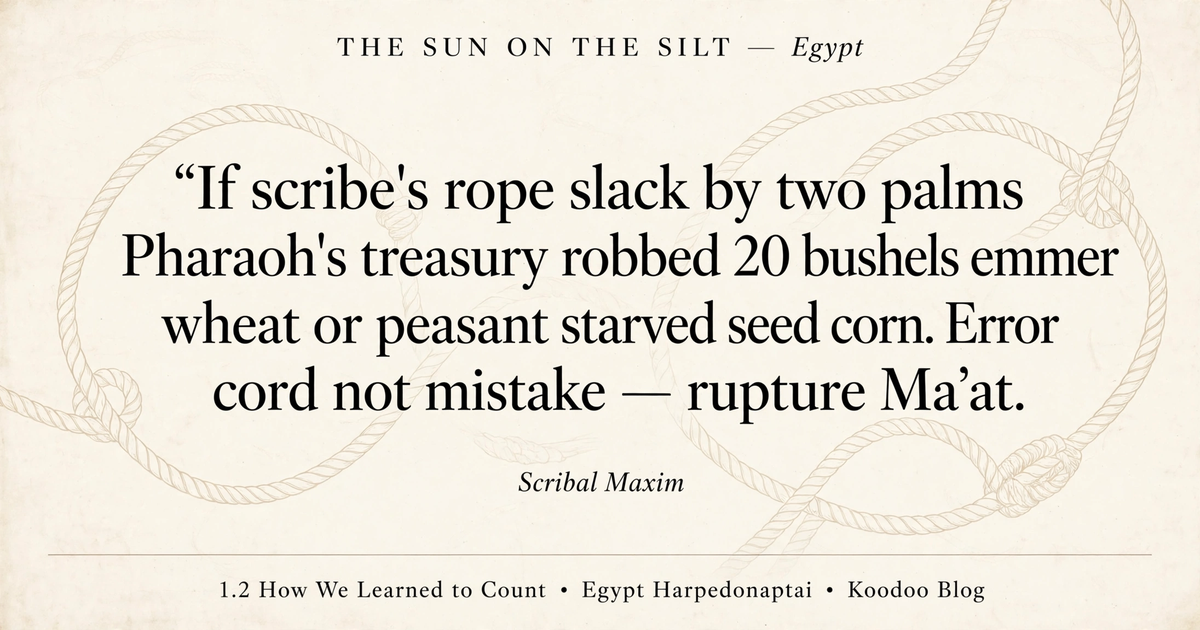
In the sixteenth century before the common era, in the administrative quarter of Thebes, a scribe named Ahmes sat at a low cedarwood table unrolling a yellowed papyrus that already felt ancient in his hands. The air smelled of brewing mash and baking sourdough drifting from the royal bakeries of the Temple of Amun, while outside some two hundred bronze-miners, stone-masons, and plasterers hammered with adzes and shouted curses at their paymasters. The men were close to full revolt because the royal grain treasury had failed to deliver the monthly beer and bread stipends, even though the bins stood full of barley and spelt. The crisis was operational rather than agricultural, for the bread batches came out in irregular sizes and the beer vats varied in strength, leaving labor squads of unequal rank feeling cheated and hungry.
Ahmes dipped his rush pen in red ink and copied an older manual from the Middle Kingdom, the document now called the Rhind Mathematical Papyrus after the Scottish collector Alexander Henry Rhind, who purchased it in Luxor in 1858. Its title promises the accurate reckoning for inquiring into things, and the knowledge of all that exists, all mysteries and all obscurities, and the title inscription is dated to around 1550 before the common era. Yet the scroll holds no spells for raising the dead and no demons or philosophical speculation, only workmanlike mathematics for people who built and brewed and measured. Its 87 practical workplace exercises cover the slope of pyramid casing stones, the volume of cylindrical grain silos, tests for whether a brewer has watered the beer, and above all the fair division of bread.
The fractional crisis behind those exercises is best seen in Problem 40, the case of the hundred loaves for five starving quarry workers. The hundred loaves must be shared among five men in an arithmetic progression, with the sum of the two smallest shares equal to one-seventh of the sum of the three largest shares, and the question is what each man receives. A wrong answer meant the senior overseer might take less bread than a junior digger, and once the hierarchy of the gang broke, the tomb work ground to a halt. Ahmes had to produce shares that every man accepted as both lawful and visibly fair, with no crumbs left for argument.
His triumph grew out of a strict doctrine of unit fractions that looks strange to modern eyes but made perfect sense at the bakery door. To a modern clerk, 7 over 10 is an ordinary number between zero and one, roughly 0.7 on the number line, but to an Egyptian scribe that reading was an absurdity because a fraction was not an abstract point but the physical act of dividing an actual loaf of bread. The physical world made the numerator an illusion, since no baker can cut three-fifths with a single stroke but can cut halves and thirds and quarters and fifths, which meant only unit parts like one-half and one-third and one-quarter and one-fifth were real, with the intuitive two-thirds admitted as a fundamental operator. Mathematics had to follow the knife rather than the other way around.
Put yourself in the shoes of Ahmes facing 7 loaves for 10 laborers, because the modern answer of seven-tenths of a loaf means nothing to a man holding a blade. Slicing each of the 7 loaves into 10 microscopic wedges would produce 7 slivers per man, and the bread would crumble into dust on the floor while the workers felt cheated and accused the overseer of stealing the crusts. Mutiny would follow the crumbs, so the scribe needed cuts that looked generous and could be checked by eye. His algorithm for decomposing unit fractions answered exactly that need with physical genius rather than abstract cleverness.
That formula meant taking 5 loaves and cutting each cleanly in half, which produces 10 substantial half-loaves so every worker receives one solid half without dispute. Then the remaining 2 loaves are each cut into 5 equal pieces, producing 10 identical one-fifth slices so every worker receives one more clean slice. Every man walks away with two respectable pieces, one half-loaf and one fifth-loaf, with no crumbs and no arguments, and the chisels strike stone again. The mathematics disappears into the fairness of the meal, which is precisely why it worked as administration.
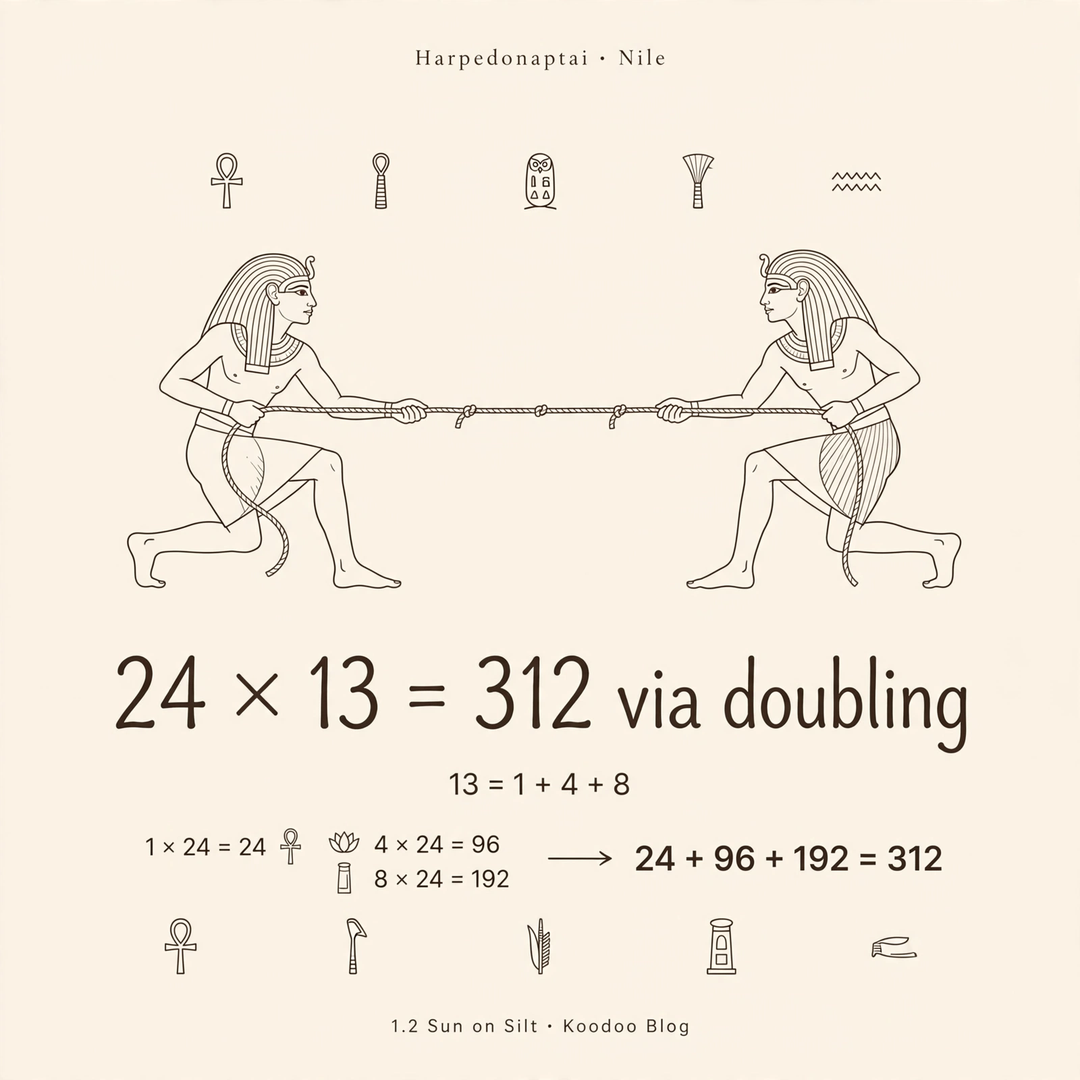
To make such splitting instant, Ahmes devoted the first section of the papyrus to a massive reference matrix, the famous table of 2 divided by n, running from 2 over 3 all the way to 2 over 101 with each entry broken into a sum of unit fractions. Readers find entries such as 2 over 5 equals 1 over 3 plus 1 over 15, and 2 over 7 equals 1 over 4 plus 1 over 28, and 2 over 13 equals 1 over 8 plus 1 over 52 plus 1 over 104, and 2 over 97 equals 1 over 56 plus 1 over 679 plus 1 over 776. A modern student might ask why the scribes wrote 1 over 4 plus 1 over 28 instead of the simpler 1 over 7 plus 1 over 7, and the answer is an iron rule of Egyptian scribal law that forbade repeating the same unit fraction in one decomposition. Writing 2 over 7 as 1 over 7 plus 1 over 7 was judged a tautological cheat that restated the problem without giving a practical cutting recipe, so every entry had to offer distinct pieces a baker could actually slice.
That brilliance was also a prison, because scribes chained to physical loaves and visual hieroglyphs could never develop general algebraic formulas that worked for all numbers at once. Complex equations had to be attacked by trial and error through the Method of False Position, preserved in the famous Aha problems that ask the reader to solve for a quantity when two-thirds plus one-half plus one-seventh of it, added together with the whole, make 33. The scribe guessed an easy number such as 42, which divides cleanly by 7 and 3 and 2, worked through the calculation to get an erroneous result, and then scaled the guess proportionally to reach the true answer. Egypt built a magnificent mathematics of stone and grain, conservative and eternal and tuned to the solar clock of the Nile, but across the Sinai desert a different civilization was already forging an arithmetic engine of terrifying speed and abstraction.
Keep reading
This is one short part of the full 38-minute monograph. Nothing here is cut from the archive - the complete chapters live together in one place.
Read full 38-min monograph /first-notch/ - Read next part: /first-notch-uruk-cuneiform-gearbox/