Full article — Read the full 38-min monograph — this is a short 5-min part for LinkedIn/Instagram.
Between 2600 and 1900 before the common era, while Egyptian pharaohs were stacking limestone at Giza and Akkadian kings were drowning Mesopotamia in blood, the largest civilization on Earth was flourishing across the vast basins of the Indus and the ancient vanished Sarasvati, known today as the Ghaggar-Hakra. Its cities included Harappa and Mohenjo-daro and Dholavira and Rakhigarhi and Lothal, names that still anchor digs across two modern nations. Spanning more than one million square kilometers and dwarfing contemporary Egypt and Mesopotamia combined, the Indus Valley Civilization presents the most haunting enigma in archaeological history, because its scale is matched by its silence about kings.
Walk through the ruins of Mohenjo-daro and Harappa today and search in vain for the monuments that define every other Bronze Age empire. There are no soaring stone pyramids and no royal tombs crammed with gold jewelry and slaughtered concubines, no basalt steles carving pictures of kings gouging the eyes of defeated captives, no giant temples towering over impoverished slums, and no barracks built for imperial armies bristling with bronze spears. Instead archaeologists have unearthed the most sophisticated and egalitarian municipal engineering of the ancient world, an architecture of equity expressed in drains rather than thrones. At Mohenjo-daro every house, from the largest merchant residence to the most modest two-room artisan dwelling, contained its own private brick bathroom connected to a city-wide underground sewer system, and beneath the wide straight avenues ran covered terracotta drainage channels with inspection manholes and silt-settling sumps that municipal sanitation workers emptied daily. Nothing comparable in public hygiene would be seen in the Western world until the imperial Roman aqueducts two thousand years later.
How did a vast and decentralized subcontinent govern itself across an empire stretching from the snows of Afghanistan to the Arabian Sea without kings or weapons or monuments. The answer was found not in a palace but in a small leather pouch beside an artisan workbench, holding a cubic chert stone weight. At every Harappan settlement excavated across thousands of miles, from the border garrison in Gujarat to the port on the Makran coast near Iran and the manufacturing city on the Ravi River in Punjab, archaeologists have found thousands of identical and beautifully polished cubes of hard dense silicate rock called chert. When those stones were brought to modern laboratories and weighed on microgram-sensitive digital balances, the result stunned the scientific world, because the weights matched across the entire subcontinent.
A weight of 10 grams found at Lothal on the shores of the Arabian Sea proved accurate within fractions of a percent when compared with a 10-gram weight found at Shortugai, fifteen hundred miles away on the banks of the Amu Darya river in northern Afghanistan. That metrological consensus exceeded the precision of eighteenth-century European nation-states, achieved without a central mint or imperial inspectors. The mathematical architecture behind the stones was a triumph of pragmatic elegance, a hybrid binary-decimal system that served small traders and great merchants at the same time.
”Indus merchant did not balance scales by royal decree balanced scales by civil consensus. Trust not enforced sword trust cast into stone.”
— Reflection on Harappan Urban MetrologyThe sequence of chert weights followed a strict mathematical progression that any balance-beam user could learn by handling the stones. The smaller everyday denominations advanced by doubling in binary fashion through 1, 2, 4, 8, 16, 32, and 64, with the base unit labeled 16 on the relative scale weighing approximately 13.71 grams. Once the scale crossed the number 16, where the traditional counting of a dozen-and-a-third survived in Indian commerce for five millennia as the 16 annas of the rupee system, the progression shifted cleanly into decimal steps of 160, 200, 320, 640, 1600, 3200, 6400, and 12800. That binary-decimal fusion was an engineering masterpiece, because the binary lower registers let an ordinary fishmonger or vegetable vendor divide food by half and quarter and eighth on a simple balance beam without touching fractions, while the decimal upper registers let a wholesale merchant trading thousands of pounds of copper ingots or carnelian beads or cotton bales beside the dockside galleys perform large-scale accounting through effortless decimal addition.
The same metrological obsession extended to fabric and buildings, where every brick manufactured in the Indus, whether lining a peasant domestic well or the great dock basin at Lothal or the defensive flood walls at Harappa, was molded and kiln-fired to an unyielding universal proportion.
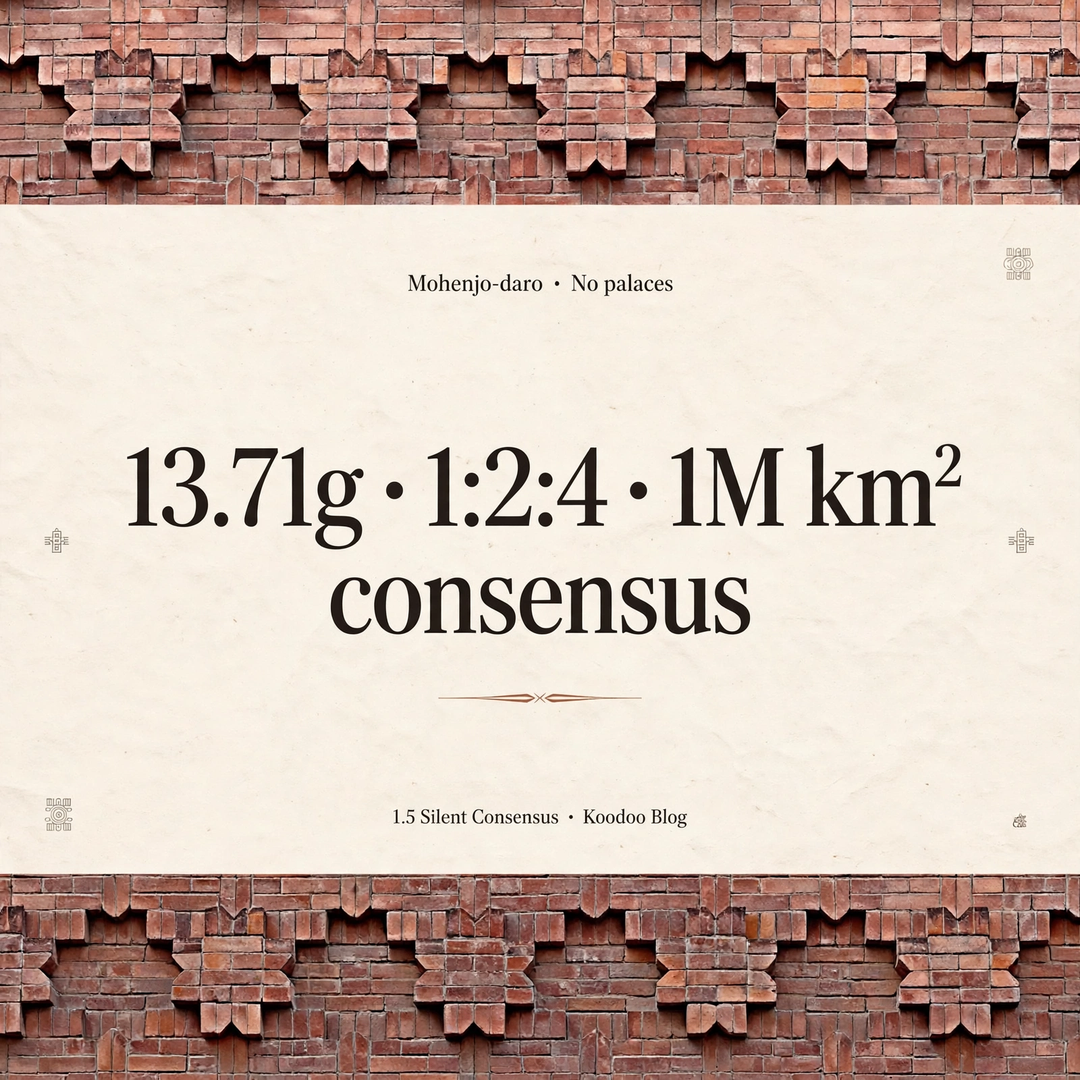
Typical bricks measured 7 centimeters by 14 centimeters by 28 centimeters, or the larger 10 by 20 by 40, and the ratio was chosen because a brick whose width is exactly twice its thickness and whose length is exactly twice its width can be laid in interlocking alternating courses of headers and stretchers without a single weak vertical seam. Those walls carried immense structural integrity against the violent lateral pressure of seasonal monsoon floods, turning a simple ratio into flood insurance for whole cities. The Indus Valley proved that mathematics did not require a bronze-sword tyrant or a bloodthirsty dragon god to achieve global scale, because standards alone, silent and invisible, held together a peaceful commercial commonwealth across a continent.
Keep reading
This is one short part of the full 38-minute monograph. Nothing here is cut from the archive - the complete chapters live together in one place.
Read full 38-min monograph /first-notch/ - Read next part: /first-notch-vedic-altar-wheel/